

The Ultimate Guide to Traditional Wedding Invitation Wording for Formal UK Weddings
Crafting the perfect wedding invitation is an art form, especially for formal UK weddings, where tradition, etiquette, and elegance converge.
The wording of a wedding invitation sets the tone for the event, conveying not only the essential details but also the formality and style of the occasion. For couples planning a traditional, formal wedding in the United Kingdom, adhering to established conventions ensures invitations reflect the sophistication and grandeur of the day.
This comprehensive guide explores the nuances of traditional wedding invitation wording for formal UK weddings, offering practical advice, examples, and tips to create invitations that are both timeless and impeccable.
Understanding the Importance of Traditional Wording
In the UK, formal wedding invitations follow a long-standing tradition rooted in etiquette and social custom. The language used is typically formal, polite, and structured, reflecting the gravity of the occasion. These invitations are more than just a means to share logistical details; they are a statement of intent, signalling the tone of the wedding and the expectations for guests. Traditional wording is particularly important for ceremonies held in prestigious venues, such as historic churches, stately homes, or grand ballrooms, where the invitation must match the event’s elegance.
The wedding invitation wording also serves a practical purpose, clearly communicating who is hosting the wedding, the nature of the event, and any specific instructions for guests. In formal UK weddings, the invitation often follows a structured format, with specific phrases and conventions that have been refined over generations.
Key Components of a Formal UK Wedding Invitation
A traditional UK wedding invitation typically includes several standard elements, each carefully worded to adhere to etiquette. Below are the key components, along with guidance on how to phrase them:
1. The Host Line
The host line indicates who is inviting guests to the wedding, traditionally the bride’s parents. However, modern variations may include both sets of parents, the couple themselves, or another host. The wording reflects the formality of the event and the hosts’ titles.
Traditional Example (Bride’s Parents Hosting):
Mr. and Mrs. James Edward Thompson request the honour of your presence at the marriage of their daughter…
Both Sets of Parents Hosting:
Mr. and Mrs. James Edward Thompson and Mr. and Mrs. William Henry Clarke request the pleasure of your company at the marriage of their children…
Couple Hosting:
Miss Charlotte Emily Thompson and Mr. Henry William Clarke request the honour of your presence at their marriage…
The phrase “request the honour of your presence” is typically used for religious ceremonies, while “request the pleasure of your company” is common for civil ceremonies or receptions.
2. The Couple’s Names
The couple’s names are presented formally, often including middle names or initials. Traditionally, the bride’s name appears first, without her surname if her parents are hosting, as it’s implied. The groom’s full name and title (e.g., Mr.) are included.
Example:
Charlotte Emily to Mr. Henry William Clarke
If the couple is hosting, both full names and titles are used.
3. Date and Time
The date and time are written out in full, avoiding abbreviations for a formal tone. The day of the week is often included, and the time is specified clearly.
Example:
on Saturday, the twenty-fifth of June, two thousand and twenty-six, at three o’clock in the afternoon
4. Venue
The venue’s name and address are included, with the city or town sometimes omitted if it’s well-known. For religious ceremonies, the name of the church or cathedral is sufficient.
Example:
at St. Mary’s Church, Chipping Norton, Oxfordshire
5. Reception Information
If the reception is held at a different location, this is noted on the invitation. The phrase “and afterwards” is commonly used to indicate the transition from ceremony to reception.
Example:
and afterwards at The Manor House, Chipping Norton
If the reception details are extensive, they may be included on a separate card.
6. RSVP Details
The RSVP line provides instructions for responding, including a deadline and contact information. In formal UK invitations, a reply card is often included, but the invitation itself may request a response directly.
Example:
RSVP by the tenth of June to [address or email]
7. Dress Code (Optional)
For formal UK weddings, a dress code may be specified, such as “Black Tie,” “Morning Dress,” or “Formal Attire.” This is typically included in the bottom right corner of the invitation.
Example:
Black Tie
8. Additional Information
Any additional details, such as “No children, please” or “Carriages at midnight,” are included discreetly, often on a separate enclosure card or at the bottom of the invitation.
Sample Traditional Wedding Invitation
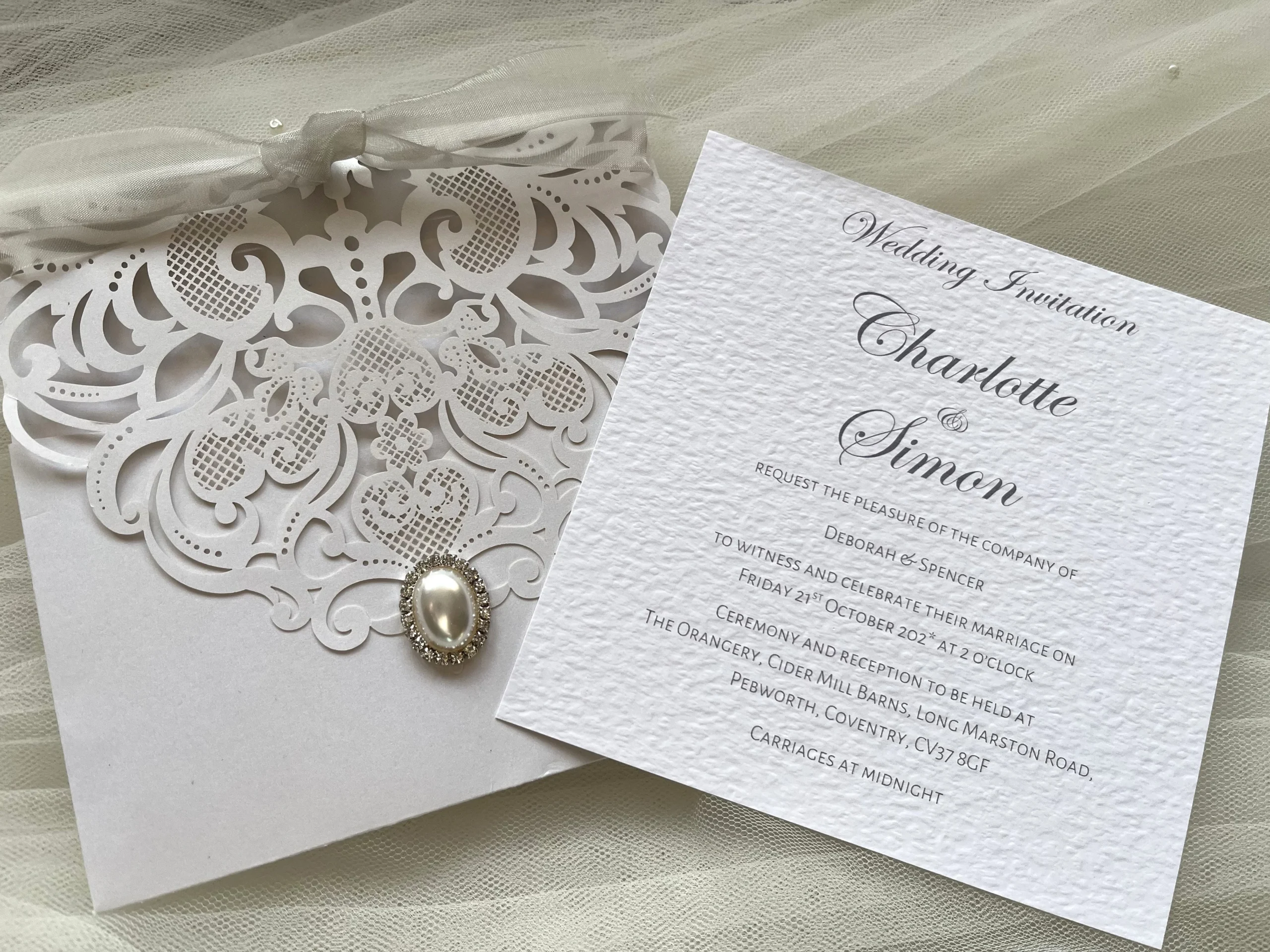
Here’s an example of a complete traditional UK wedding invitation:
Mr. and Mrs. James Edward Thompson
request the honour of your presence
at the marriage of their daughter
Charlotte Emily
to Mr. Henry William Clarke
on Saturday, the twenty-fifth of June,
two thousand and twenty-six,
at three o’clock in the afternoon
at St. Mary’s Church, Chipping Norton, Oxfordshire
and afterwards at The Manor House, Chipping Norton
RSVP by the tenth of June
[Address]
Black Tie
Etiquette and Style Considerations
Formal Language
The language should be formal and free of contractions (e.g., “do not” instead of “don’t”). British English spellings, such as “honour” and “favour,” are standard for UK weddings.
Titles and Honorifics
Use appropriate titles (e.g., Mr., Mrs., Dr., The Honourable) for hosts and the couple. If the groom holds a military or noble title, such as “Captain” or “The Viscount,” it should be included.
Addressing Divorced or Remarried Parents
For divorced parents, list each parent separately with their current title or name:
Example:
Mrs. Elizabeth Mary Thompson and Mr. James Edward Thompson request…
If a parent has remarried, include their current spouse if they are co-hosting:
Example:
Mr. and Mrs. David Robert Langley and Mr. James Edward Thompson request…
Same-Sex Weddings
For same-sex couples, the wording follows the same structure, with both names presented formally. The host line may reflect the couple or their parents, depending on who is hosting.
Example:
Mr. Thomas Edward Wilson and Mr. Oliver James Hartley request the pleasure of your company at their marriage…
Enclosure Cards
Formal UK wedding invitations often include separate cards for additional details, such as:
Reception Card: Provides details about the reception if not included on the main invitation.
Directions Card: Includes venue directions or accommodation information.
RSVP Card: A pre-addressed card with a stamped envelope for guests to return.
Tips for Perfecting Your Invitations
Choose High-Quality Stationery: Opt for heavy cardstock, embossed or engraved printing, and elegant fonts like serif or script styles (e.g., Times New Roman or Copperplate). White or cream paper is traditional, though soft pastels are also acceptable.
Proofread Carefully: Ensure all names, dates, and details are correct. Have multiple people review the wording to catch errors.
Work with a Professional Stationer: A reputable stationer familiar with UK wedding traditions can guide you through the process and ensure adherence to etiquette.
Send Invitations Early: Formal UK wedding invitations are typically sent 6-8 weeks before the wedding, with RSVPs requested 3-4 weeks in advance.
Consider Cultural Sensitivities: If inviting guests from diverse backgrounds, ensure the wording is inclusive and clear. For example, specify if the ceremony is religious or secular.
Include a Website (Optional): While not traditional, a wedding website can provide additional details (e.g., registry, accommodation) without cluttering the invitation. Mention it discreetly:
For further details, please visit [website URL].
Common Mistakes to Avoid
Overloading the Invitation: Keep the main invitation concise, using enclosure cards for extra details.
Ignoring Hierarchy: List hosts and the couple in the correct order of prominence (e.g., parents before the couple if they are hosting).
Inconsistent Tone: Ensure the wording matches the formality of the event. Avoid casual phrases like “join us” for a black-tie wedding.
Incorrect Timing: Sending invitations too late can inconvenience guests, especially for destination weddings.
Modern Twists on Tradition
While traditional wording is timeless, some couples incorporate subtle modern elements. For example:
Adding a personal touch, such as a monogram or family crest.
Using eco-friendly paper or digital RSVPs to align with sustainable values.
Including a short poem or quote, provided it maintains a formal tone.
Conclusion
The wording of a traditional UK wedding invitation is a delicate balance of formality, clarity, and elegance. By adhering to established conventions, such as using proper titles, formal language, and structured components, couples can create invitations that reflect the sophistication of their event. Whether hosted by parents or the couple themselves, the invitation should convey the significance of the day while providing guests with all necessary information. With careful attention to detail and a nod to tradition, your wedding invitations will set the perfect tone for a memorable formal UK wedding.
This article is brought to you in conjunction with Daisy Chain Invites, a 5 star Trustpilot UK wedding invitation printing company and supplier of matching wedding stationery.
Who should be listed as the hosts on a traditional UK wedding invitation?
Traditionally, the names of whoever is hosting (usually paying for) the wedding appear on the first line. Most commonly this is the bride’s parents, e.g.
“Mr and Mrs John Smith
request the pleasure of your company
at the marriage of their daughter…”
If both sets of parents are hosting, list them together; if the couple are hosting themselves, start with the couple’s names.
“Request the pleasure of your company” is used when the ceremony is in a secular venue (hotel, registry office, stately home).
“Request the honour of your presence” (spelt with a “u”) is the traditional phrasing reserved for a religious ceremony (church, synagogue, temple, etc.).
Common polite formats:
If remarried: “Mrs Jane and Mr Michael Brown / Mr David and Mrs Sarah Jones…”
If one parent is hosting alone: “Mrs Jane Brown” or “Mr David Jones” on the first line
If both parents are hosting separately: list them on separate lines
Example: “Mrs Jane Brown and Mr David Jones request the pleasure…”
Yes – traditional British etiquette includes full formal names (first, middle, and surname) for the bride and groom. Nicknames or shortened names are never used on formal invitations.
Numbers are always written in words, never numerals.
Correct:
“on Saturday, the tenth of May
two thousand and twenty-five
at three o’clock”
The year is written in full, and “in the afternoon” or “in the evening” is added after the time if needed.
Classic versions:
“and afterwards at the reception / The Dorchester Hotel”
“followed by a reception at…”
If reception immediately after: “at half past three o’clock” (for ceremony + reception in the same venue)
If the reception is evening-only, a separate evening invitation or line is sent: “and afterwards at dinner and dancing…”
Yes – traditional etiquette requires it. The correct format is in the bottom left corner:
“R.S.V.P.
By the first of April
The Old Rectory, Much Marcle
Herefordshire HR8 2LY”
or with a reply card: “The favour of a reply is requested by…”
Phone numbers and email addresses are acceptable on formal invitations in 2026, but many couples still prefer postal address only.