

The Ultimate Guide to Planning Your Destination Wedding Abroad (and Actually Enjoying It)”
Your Ultimate No-Stress Planning Checklist
The Ultimate Guide to Planning Your Destination Wedding Abroad (and Actually Enjoying It)”
Planning a wedding abroad is one of the most exciting (and occasionally overwhelming) things you’ll ever do. Crystal-clear water, sunset vows, and a week-long party with your favourite people – yes please! But before you pin 47 Pinterest boards, here’s the ultimate guide that couples, planners, and seasoned bridesmaids swear by. Grab a coffee (or a spritz) – this is everything you need to know.
1. The Legal Bit – Get This Sorted First
Nothing kills the vibe faster than realising your dream Maldives beach ceremony isn’t legally binding back home. Ask yourself three questions:
Is a wedding in your chosen country automatically recognised in the UK? (Greece, Italy, Spain, France, Cyprus, USA, Portugal = yes. Seychelles, Fiji, Maldives, Mauritius, most Caribbean islands = usually symbolic only.)
How long do you need to be resident before the ceremony? Examples: France requires 40 days, Italy wants you there at least a week for paperwork, Greece and Cyprus just 3 clear working days.
What documents do you need? Expect full birth certificates, Certificate of No Impediment (CNI – valid 3–6 months), passports, proof of divorce/death if applicable, plus sworn translations.
Budget £500–£2,500 for paperwork, translators, and courier fees. Pro tip: do the quick legal ceremony at your UK registry office two days before you fly (many couples now do this and keep it secret – the abroad day still feels 100% real).

2. Timing Is Everything
Save the Dates: 12–18 months ahead (yes, really). People need to request annual leave and hunt cheap flights.
Formal invitations: 6–9 months before travel.
Mid-week weddings (Tuesday–Thursday) can slash venue and flight costs by 30–50%.
School holidays = higher attendance but higher prices. Shoulder season (May, September, October) is usually the sweet spot.
Real talk: acceptance rates abroad average 60–80%. Pick a destination people already want to visit (Santorini, Amalfi, Tuscany, Bali) and you’ll be closer to 90%.
3. Season & Weather Reality Check
Greece & Croatia: May/June or Sept/Oct (July–Aug hits 40°C and islands are packed).
Italy: April–June & Sept–Oct (August is meltdown-hot and half the country closes for Ferragosto).
Mexico & Caribbean: November–April (hurricane season runs June–November – insurance becomes expensive).
Bali & Thailand: May–October dry season.
South Africa & New Zealand: their summer = our winter (Dec–March).
Check historical weather on sites like Weather Spark – don’t just trust “sunny Mediterranean”.
4. Budget: The Honest Numbers (2025 Prices)
Average cost for 40–60 guests abroad: £25,000–£55,000 total. That often works out cheaper per head than 120 guests in a UK barn, and you get a castle/vineyard/beach club instead of a wet marquee.
Biggest savings:
Venue + food: £6k–£15k abroad vs £18k–£30k UK
Fewer guests = less spend on favours, transport, etc.
Biggest surprises:
Guest welcome bags, day-two brunch, group activities add up fast.
Currency fluctuations – lock rates or use Wise/Revolut.
Resort “wedding packages” often sneak in hidden fees.
5. Location & Logistics That Make Life Easy
Choose somewhere with direct flights from at least two major UK airports (or pay the price in grumpy guests).
Block-book hotels 9–12 months out – you usually get 1 free room for every 10–15 booked.
Organise group airport transfers. Guests will love you forever.
Build a wedding website early with live flight price widgets, hotel links, packing lists, and an FAQ page.
6. Hire the Right Help
A local planner based in your destination is worth triple their fee. They know which florist delivers on time, which priest speaks English, and how to bribe the town hall if paperwork goes sideways.
UK celebrant for a personal ceremony if you did the legal bit at home.
Photographer who’s shot at your venue before – travel fees hurt less when they already know the golden-hour spots.

7. Guest Experience = Your New Full-Time Job
Welcome bags on arrival beds: water, crisps, itinerary, paracetamol, sun cream, handwritten note.
Schedule a free evening after travel day – jet-lagged guests in 35°C heat is not cute.
Offer one or two paid group activities (catamaran sunset cruise, pizza-making class) but always give a “chill by the pool” option.
Over-communicate: WhatsApp group, printed itinerary in rooms, QR codes on tables.

8. Insurance and Plan B
Specialist wedding-abroad insurance (John Lewis, WeddingPlan, Dreamsaver).
Rain plans – most top venues now have stunning indoor backups, but check.
Health & travel insurance that covers every guest’s activities (some don’t cover scuba or quad bikes on hen/stag trips).
9. The Invitation Game
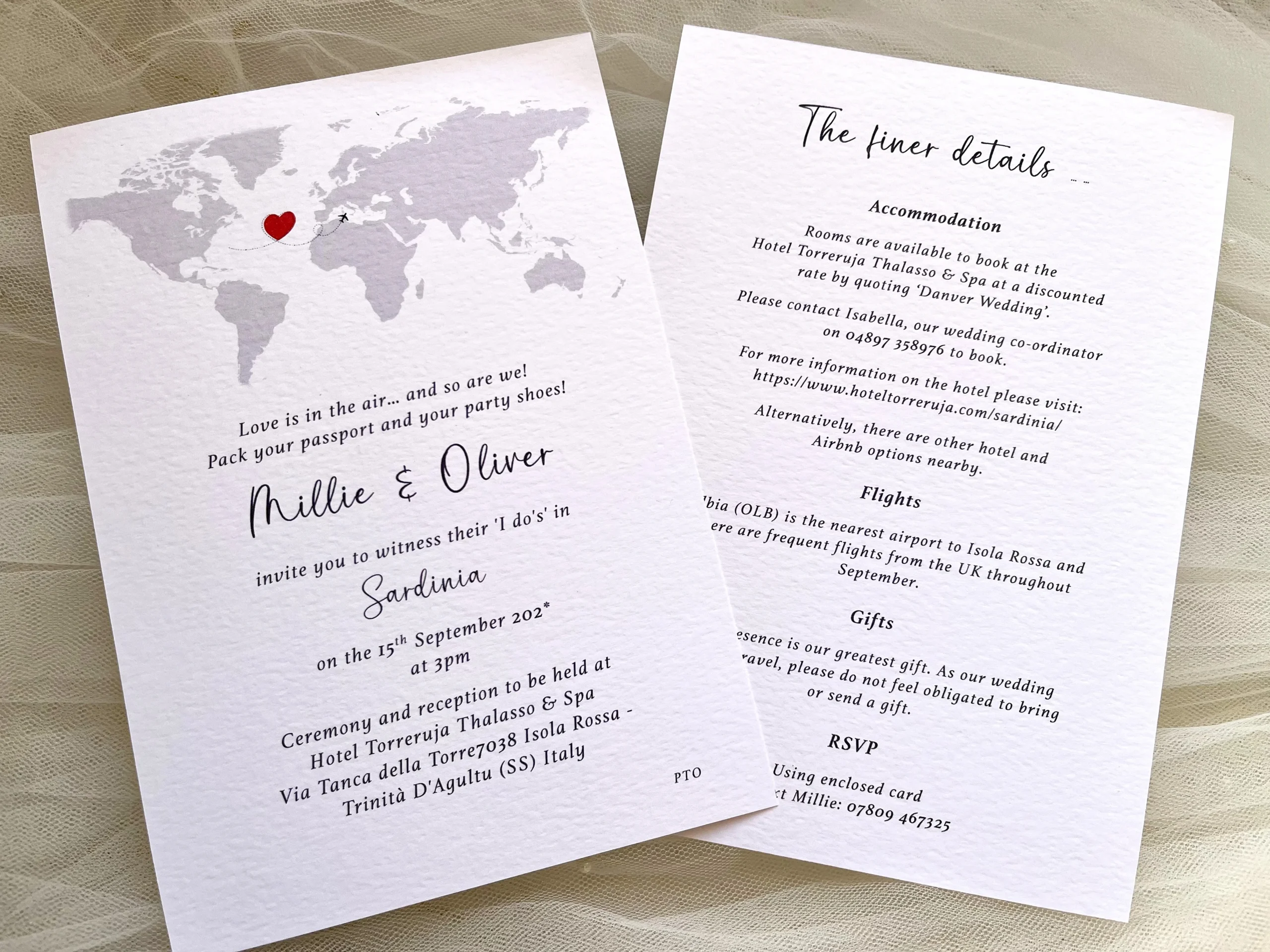
The “Love is in the Air” invitation is perfect because it screams “adventure starts now”.
Final Thought from Couples Who’ve Done It
“We spent the same as we would have on 120 people in a cold UK November… but had 50 of our nearest and dearest in a Tuscan castle eating truffles at sunset for a week. Best decision we ever made.”
Do the paperwork early, choose a place you’d happily honeymoon even if zero guests came, over-communicate with your people, and hire local experts. Then kick back with a gelato – the views will decorate themselves.
Now go book that flight. Your dream wedding is waiting at the arrivals gate. ✈️💍
Beach Wedding Ideas
Theme & Decor
Colour palette: Soft neutrals with ocean-inspired tones like seafoam green, coral, and sandy beige.
Decor elements: Driftwood arches, seashell centrepieces, lanterns, and string lights for sunset ambiance.
Seating: Wooden or bamboo chairs with light fabric drapes to complement the natural setting.
Attire
Bride: Flowy chiffon or lace gown, barefoot sandals, or simple wedges.
Groom: Linen suit or light-coloured shirt with rolled sleeves and khaki trousers.
Guests: Encourage light, breathable fabrics and sun hats.
Ceremony & Reception
Timing: Late afternoon for cooler weather and golden-hour photos.
Music: Acoustic guitar, ukulele, or soft instrumental background.
Food & Drinks: Fresh seafood, tropical fruits, and signature cocktails like mojitos or piña coladas.
Extras
Provide flip-flops or barefoot zones for guests.
Offer sunscreen and fans as part of a welcome kit.
Use eco-friendly confetti like flower petals or biodegradable paper.
This article was brought to you in collaboration with Daisy Chain Invites, a UK supplier of quality wedding invitations and wedding stationery. #destinationwedding #abroadweddings #weddingsabroad #beachweddings
#namecardtablewedding #namesontablecardsforwedding #personalisedplacecards #weddingnamecard table affordable wedding invitations affordable wedding invites Autumn Wedding Ideas autumn weddings Budget Weddings cheap wedding invitations civil ceremony books daisy chain invites digital wedding invitations Eucalyptus Wedding Invitations gift cards Honeymoon Information Cards minimalist wedding invitations modern wedding invitations new wedding invitations new wedding stationery personalised wedding invitations readings for weddings save the date cards Wedding Ceremony Books wedding checklist wedding etiquette wedding guide Wedding Inspiration wedding invitation card wedding invitation etiquette wedding invitations wedding invitations card wedding invitations uk wedding invitation wording Wedding Invites wedding money saving ideas wedding order of service wedding planning wedding poems Weddings wedding stationery wedding tips Wedding Traditions wedding trends
The ideal time depends on your chosen location. Generally, aim for shoulder seasons (spring or autumn) to avoid extreme heat, hurricanes, or peak tourist prices. For Europe, May–June and September–October are perfect; for the Caribbean, December–April is safest. Always check the destination’s rainy or hurricane season before booking.
12–18 months is recommended. This gives you time to research legal requirements, secure your dream venue before it books up, and allows guests to save and arrange travel. If you’re flexible on dates or venues, 9–12 months can still work.
It depends on the country. Many popular destinations (Italy, France, Greece, Mexico, etc.) have strict residency or paperwork rules. Lots of couples choose a quick legal ceremony at home (often just the two of you at the registry office) and then have the big symbolic celebration abroad – it removes stress and bureaucracy on the day.
The average is 30–60 guests (compared to 100–150 for a UK wedding). Guests self-select – only those who really want to celebrate with you will make the journey, which often creates a more intimate and joyful atmosphere.
Surprisingly similar or cheaper! Many couples spend £15,000–£30,000 for 40–60 guests abroad (including travel and accommodation) versus £25,000–£40,000+ for a traditional UK wedding with 120 guests. All-inclusive resorts and favourable euro/exchange rates often make it excellent value.
No – tradition and etiquette say guests cover their own travel and accommodation. You usually cover the wedding day itself (ceremony, reception, food, drinks) and often host a welcome party and day-after brunch. Providing a room block with negotiated rates is greatly appreciated.
Typical requirements include:
Full birth certificates
Passports
Decree absolute (if previously divorced)
Certificate of No Impediment (CNI)
Affidavits or statutory declarations
Some countries require documents to be translated and apostilled. Always check with the specific country’s embassy or your wedding planner 12 months in advance.